With Daytime Temperatures That Can Reach 430ã‚â°c, Why Is Nighttime on Mercury So Cold?
Deserts are areas that receive very piddling atmospheric precipitation. People often use the adjectives "hot," "dry," and "empty" to draw deserts, just these words practice not tell the whole story. Although some deserts are very hot, with daytime temperatures as high as 54°C (130°F), other deserts have cold winters or are cold year-round. And almost deserts, far from being empty and lifeless, are domicile to a variety of plants, animals, and other organisms. People have adapted to life in the desert for thousands of years. One affair all deserts have in mutual is that they are barren, or dry out. Nigh experts agree that a desert is an area of land that receives no more than 25 centimeters (x inches) of atmospheric precipitation a year. The amount of evaporation in a desert oftentimes greatly exceeds the annual rainfall. In all deserts, there is picayune h2o available for plants and other organisms. Deserts are institute on every continent and cover about one-5th of World's land expanse. They are dwelling house to around one billion people—one-sixth of the Earth's population. Although the give-and-take "desert" may bring to mind a bounding main of shifting sand, dunes comprehend only about ten percent of the world's deserts. Some deserts are mountainous. Others are dry expanses of stone, sand, or salt flats. Kinds of Deserts The world's deserts can be divided into five types—subtropical, coastal, rain shadow, interior, and polar. Deserts are divided into these types according to the causes of their dryness. Subtropical Deserts Hot, moist air rises into the atmosphere near the Equator. Every bit the air rises, it cools and drops its moisture as heavy tropical rains. The resulting cooler, drier air mass moves away from the Equator. Equally it approaches the tropics, the air descends and warms up once more. The descending air hinders the germination of clouds, then very lilliputian rain falls on the land beneath. The world's largest hot desert, the Sahara, is a subtropical desert in northern Africa. The Sahara Desert is about the size of the entire continental United States. Other subtropical deserts include the Kalahari Desert in southern Africa and the Tanami Desert in northern Australia. Coastal Deserts The Atacama Desert, on the Pacific shores of Chile, is a coastal desert. Some areas of the Atacama are often covered by fog. But the region tin go decades without rainfall. In fact, the Atacama Desert is the driest place on Globe. Some weather stations in the Atacama accept never recorded a drop of rain. Rain Shadow Deserts When moisture-laden air hits a mountain range, it is forced to ascension. The air and so cools and forms clouds that drib moisture on the windward (wind-facing) slopes. When the air moves over the mountaintop and begins to descend the leeward slopes, at that place is fiddling moisture left. The descending air warms upwardly, making it hard for clouds to form. Death Valley, in the U.S. states of California and Nevada, is a pelting shadow desert. Death Valley, the lowest and driest identify in North America, is in the rain shadow of the Sierra Nevada mountains. Interior Deserts The Gobi Desert, in China and Mongolia, lies hundreds of kilometers from the body of water. Winds that reach the Gobi accept long since lost their moisture. The Gobi is likewise in the rain shadow of the Himalaya mountains to the south. Polar Deserts The largest desert in the globe is also the coldest. Near the entire continent of Antarctica is a polar desert, experiencing little precipitation. Few organisms can withstand the freezing, dry climate of Antarctica. Changing Deserts The regions that are deserts today were not always so dry. Between 8000 and 3000 BCE, for instance, the Sahara had a much milder, moister climate. Climatologists identify this period as the "Green Sahara." Archaeological evidence of past settlements is arable in the middle of what are arid, unproductive areas of the Sahara today. This evidence includes rock paintings, graves, and tools. Fossils and artifacts prove that lime and olive trees, oaks, and oleanders once bloomed in the Sahara. Elephants, gazelles, rhinos, giraffes, and people used stream-fed pools and lakes. In that location were three or four other moist periods in the Sahara. Similar lush conditions existed every bit recently as 25,000 years ago. Between the moist periods came periods of dryness much like today'due south. The Sahara is not the but desert to have dramatic climate change. The Ghaggar River, in what is at present Bharat and Pakistan, was a major water source for Mohenjo-daro, an urban area of the ancient Indus Valley Civilization. Over fourth dimension, the Ghaggar changed grade and now only flows during the rainy monsoon season. Mohenjo-daro is now a part of the vast Thar and Cholistan deserts. Most of Earth'due south deserts volition continue to undergo periods of climatic change. Desert Characteristics Humidity—h2o vapor in the air—is near zero in most deserts. Light rains oft evaporate in the dry air, never reaching the ground. Rainstorms sometimes come as trigger-happy cloudbursts. A cloudburst may bring as much every bit 25 centimeters (ten inches) of rain in a single hour—the merely pelting the desert gets all twelvemonth. Desert humidity is usually so depression that not enough water vapor exists to form clouds. The sun'south rays beat down through cloudless skies and bake the land. The ground heats the air and so much that air rises in waves you can actually run across. These shimmering waves confuse the eye, causing travelers to see distorted images called mirages. Temperature extremes are a characteristic of most deserts. In some deserts, temperatures rising so high that people are at risk of dehydration and even death. At night, these areas cool chop-chop because they lack the insulation provided past humidity and clouds. Temperatures tin drop to 4°C (40°F) or lower. In the Chihuahuan Desert, in the United States and Mexico, temperatures can vary past dozens of degrees in one twenty-four hour period. Daytime temperatures in the Chihuahua tin can climb beyond 37°C (100°F), while nighttime temperatures can dip below freezing (0°C or 32°F). Winds at speeds of nearly 100 kilometers per hr (60 miles per hr) sweep through some deserts. With little vegetation to cake it, the wind can carry sand and dust across unabridged continents and fifty-fifty oceans. Windstorms in the Sahara bung so much material into the air that African dust sometimes crosses the Atlantic Sea. Sunsets on the Atlantic declension of the U.S. state of Florida, for example, tin be tinted yellow. First-time visitors to deserts are often amazed by the unusual landscapes, which may include dunes, towering blank peaks, flat-topped rock formations, and smoothly polished canyons. These features differ from those of wetter regions, which are often gently rounded by regular rainfall and softened by lush vegetation. Water helps cleave desert lands. During a sudden tempest, water scours the dry, hard-baked land, gathering sand, rocks, and other loose fabric as information technology flows. Every bit the muddy water roars downhill, it cuts deep channels, called arroyos or wadis. A thunderstorm can transport a fast-moving torrent of water—a flash overflowing—down a dry out arroyo. A wink overflowing similar this tin sweep away anything and anyone in its path. Many desert regions discourage visitors from hiking or camping in arroyos for this reason. Even urban areas in deserts tin can be vulnerable to flash floods. The city of Jeddah, Saudi arabia, sits in the Arabian Desert. In 2011, Jeddah was struck by a sudden thunderstorm and flash inundation. Roads and buildings were washed away, and more 100 people died. Even in a desert, water and wind eventually wear abroad softer rock. Sometimes, rock is carved into tablelike formations such as mesas and buttes. At the pes of these formations, h2o drops its burden of gravel, sand, and other sediment, forming deposits called alluvial fans. Many deserts accept no drainage to a river, lake, or body of water. Rainwater, including water from flash floods, collects in large depressions called basins. The shallow lakes that course in basins somewhen evaporate, leaving playas, or common salt-surfaced lake beds. Playas, likewise called sinks, pans, or salt flats, tin be hundreds of kilometers broad. The Black Rock Desert in the U.S. state of Nevada, for example, is all that remains of the prehistoric Lake Lahontan. The hard, apartment surface of desert salt flats are oft ideal for car racing. In 1997, British pilot Andy Light-green gear up the land speed record in Black Rock Desert—1,228 kilometers per hour (763 miles per hr). Light-green'due south vehicle, the ThrustSSC, was the offset auto to break the sound barrier. Current of air is the master sculptor of a desert's hills of sand, called dunes. Wind builds dunes that rise as high every bit 180 meters (590 feet). Dunes migrate constantly with the wind. They ordinarily shift a few meters a year, simply a particularly violent sandstorm tin move a dune 20 meters (65 feet) in a single twenty-four hour period. Sandstorms may bury everything in their path—rocks, fields, and even towns. Ane legend holds that the Farsi Emperor Cambyses II sent an army of 50,000 men to the Siwa Oasis in western Egypt around 530 BCE. Halfway there, an enormous sandstorm swallowed the entire group. Archaeologists in the Sahara accept been unsuccessfully looking for the "Lost Regular army of Cambyses" ever since. H2o in the Desert Rain is usually the main source of water in a desert, only information technology falls very rarely. Many desert dwellers rely on groundwater, stored in aquifers below the surface. Groundwater comes from rain or other precipitation, similar snowfall or hail. Information technology seeps into the ground, where it can remain for thousands of years. Clandestine water sometimes rises to the surface, forming springs or seeps. A fertile dark-green area called an oasis, or cienega, may be about such a water source. About 90 major, inhabited oases dot the Sahara. These oases are supported by some of the world'due south largest supplies of underground water. People, animals, and plants all environment these oases, which provide stable access to h2o, food, and shelter. When groundwater doesn't seep to the surface, people oft drill into the footing to go to it. Many desert cities, from the American Southwest to the Middle East, rely heavily on such aquifers to fill their h2o needs. Rural Israeli communities called kibbutzim rely on aquifers to replenish water for crops and fifty-fifty fish farming in the dry Negev Desert. Drilling into aquifers provides water for drinking, agriculture, industry, and hygiene. However, it comes at a cost to the environment. Aquifers take a long time to refill. If desert communities use groundwater faster than it is replenished, water shortages tin can occur. The Mojave Desert, in southern California and Nevada, for instance, is sinking due to aquifer depletion. The booming desert communities of Las Vegas, Nevada, and California'due south "Inland Empire" are using water faster than the aquifer is existence refilled. The water level in the aquifer has sunk equally much as 30 meters (100 feet) since the 1950s, while the country above the aquifer has sunk as much equally 10 centimeters (4 inches). Rivers sometimes provide water in a desert. The Colorado River, for instance, flows through three deserts in the American Southwest: the Keen Basin, the Sonoran, and the Mojave. Vii states—Wyoming, Colorado, Utah, New Mexico, Nevada, Arizona, and California—rely on the river for some of their h2o supply. People often modify rivers to help distribute and store water in a desert. The Nile River ecosystem dominates the eastern role of the Sahara Desert, for case. The Nile provides the most reliable, plentiful source of freshwater in the region. Between 1958 and 1971, the regime of Egypt constructed a massive dam on the Upper Nile (the southern part of the river, near Arab republic of egypt's border with Sudan). The Aswan Dam harnesses the power of the Nile for hydroelectricity used in industry. It also stores h2o in a manmade lake, Lake Nasser, to protect the land's communities and agriculture against drought. Structure of the Aswan High Dam was a huge engineering science project. Local desert communities tin can divert rivers on a smaller scale. Throughout the Middle E, communities take dug artificial wadis, where freshwater can menstruum during rainy seasons. In countries similar Republic of yemen, artificial wadis can deport enough water for whitewater rafting trips during certain times of the year. When deserts and h2o supplies cross state and national borders, people often fight over h2o rights. This has happened among u.s.a. in the Colorado River Basin, which have negotiated for many years over the partition of the river's water. Rapidly expanding populations in California, Nevada, and Arizona have compounded the trouble. Agreements that were made in the early 20th century failed to business relationship for Native American water rights. Mexican admission to the Colorado, which has its delta in the Mexican state of Baja California, was ignored. Desert agriculture, including cotton wool production, demanded a big portion of the Colorado. The ecology impact of dams was not considered when the structures were built. States of the Colorado River Basin continue to negotiate today to gear up for population growth, agronomical development, and the possibility of future droughts. Life in the Desert Plants and animals adjust to desert habitats in many ways. Desert plants abound far apart, allowing them to obtain as much water around them every bit possible. This spacing gives some desert regions a desolate appearance. In some deserts, plants have unique leaves to capture sunlight for photosynthesis, the process plants utilise to make food. Small pores in the leaves, chosen stomata, accept in carbon dioxide. When they open, they likewise release h2o vapor. In the desert, all these stomata would speedily dry out a plant. So desert plants typically have tiny, waxy leaves. Cactuses have no leaves at all. They produce food in their green stems. Some desert plants, such as cactuses, accept shallow, wide-spreading root systems. The plants soak up water speedily and store it in their cells. Saguaro cactuses, which alive in the Sonoran Desert of Arizona and northern United mexican states, expand like accordions to store h2o in the cells of their trunks and branches. A big saguaro is a living storage tower that can hold hundreds of liters of water. Other desert plants have very deep roots. The roots of a mesquite tree, for instance, can attain h2o more xxx meters (100 feet) underground. Mesquites, saguaros, and many other desert plants likewise have thorns to protect them from grazing animals. Many desert plants are annuals, which ways they only alive for one flavour. Their seeds may prevarication fallow for years during long dry out spells. When rain finally comes, the seeds sprout rapidly. Plants grow, bloom, produce new seeds, and dice, frequently in a brusk span of time. A soaking rain tin change a desert into a wonderland of flowers almost overnight. Animals that have adapted to a desert environment are chosen xerocoles. Xerocoles include species of insects, reptiles, birds, and mammals. Some xerocoles avert the lord's day past resting in scarce shade. Many escape the heat in cool burrows they dig in the ground. The fennec flim-flam, for instance, is native to the Sahara Desert. Fennec fox communities work together to dig large burrows, some as large as 93 foursquare meters (i,000 square feet). Dew can collect in these burrows, providing the foxes with fresh water. Even so, fennec foxes accept adapted so they do not have to drink water at all: Their kidneys retain enough water from the food they eat. Near xerocoles are nocturnal. They sleep through the hot days and practise their hunting and foraging at night. Deserts that seem desolate during the 24-hour interval are very agile in the cool night air. Foxes, coyotes, rats, and rabbits are all nocturnal desert mammals. Snakes and lizards are familiar desert reptiles. Insects such as moths and flies are abundant in the desert. Nearly desert birds are restricted to areas about h2o, such as river banks. Withal, some birds, such as the roadrunner, have adapted to life in the desert. The roadrunner, native to the deserts of North America, obtains h2o from its food. Some xerocoles have bodies that help them handle the rut. A desert tortoise'southward thick shell insulates the creature and reduces water loss. Sand lizards, native to the deserts of Europe and Asia, are nicknamed "dancing lizards" considering of the way they quickly lift one leg at a fourth dimension off the hot desert sand. A jackrabbit's long ears contain blood vessels that release oestrus. Some desert vultures urinate on their own legs, cooling them by evaporation. Many desert animals take developed ingenious ways of getting the water they need. The thorny devil, a lizard that lives in the Australian Outback, has a organisation of tiny grooves and channels on its body that pb to its mouth. The lizard catches pelting and dew in these grooves and sucks them into its mouth by gulping. Camels are very efficient h2o users. The animals do not shop water in their humps, every bit people one time believed. The humps shop fatty. Hydrogen molecules in the fatty combine with inhaled oxygen to course water. During a shortage of food or water, camels draw upon this fatty for diet and moisture. Dromedary camels, native to the Arabian and Sahara deserts, tin lose up to 30 percent of their trunk weight without harm. Camels, nicknamed "ships of the desert," are widely used for transportation, meat, and milk in the Maghreb (a region in Northwest Africa), the Heart East, and the Indian Subcontinent. People and the Desert Nearly 1 billion people live in deserts. Many of these people rely on centuries-old customs to brand their lives as comfortable equally possible Civilizations throughout the Middle East and Maghreb take adapted their wearable to the hot, dry out conditions of the Sahara and Arabian deserts. Wearable is versatile and based on robes made of rectangles of fabric. Long-sleeved, total-length, and oftentimes white, these robes shield all but the head and hands from the wind, sand, rut, and cold. White reflects sunlight, and the loose fit allows cooling air to flow across the peel. These robes of loose cloth can be adjusted (folded) for length, sleeves, and pockets, depending on the wearer and the climate. A thobe is a total-length, long-sleeved white robe. An abaya is a sleeveless cloak that protects the wearer from dust and estrus. A djebba is a short, square pullover shirt worn by men. A kaffiyeh is a rectangular piece of cloth folded loosely around the caput to protect the wearer from sunday exposure, dust, and sand. Information technology tin can be folded and unfolded to encompass the mouth, olfactory organ, and eyes. Kaffiyehs are secured around the head with a cord called an agal. A turban is similar to a kaffiyeh, but wrapped effectually the head instead of being secured with an agal. Turbans are too much longer—up to six meters (20 feet)! Desert dwellers accept also adjusted their shelters for the unique climate. The aboriginal Anasazi peoples of the southwestern U.s. and northern Mexico synthetic huge flat complexes in the rocky cliffs of the Sonoran Desert. These cliff dwellings, sometimes dozens of meters off the footing, were constructed with thick, earthen walls that provided insulation. Although temperatures outside varied greatly from day to night, temperatures inside did not. Tiny, high windows let in just a little light and helped keep out dust and sand. The need to find food and water has led many desert civilizations to become nomadic. Nomadic cultures are those that do non have permanent settlements. In the deserts of the Middle East and Asia, nomadic tent communities continue to flourish. Tent walls are made of thick, sturdy cloth that tin can go along out sand and dust, simply also allow cool breezes to accident through. Tents can be rolled up and transported on pack animals (usually horses, donkeys, or camels). Nomads move frequently so their flocks of sheep and goats will have water and grazing land. Also animals like camels and goats, a variety of desert vegetation is found in oases and forth the shores of rivers and lakes. Figs, olives, and oranges thrive in desert oases and accept been harvested for centuries. Some desert areas rely on resources brought from more than fertile areas—food trucked in from distant farmlands or, more oft, water piped from wetter regions. Large areas of desert soil are irrigated by h2o pumped from hole-and-corner sources or brought by culvert from afar rivers or lakes. The booming Inland Empire of southeastern California is fabricated upwards of deserts (the Mojave and the Sonoran) that rely on water for agriculture, industry, and residential evolution. Canals and aqueducts supply the Inland Empire with water from the Colorado River, to the due east, and the Sierra Nevada snowmelt to the north. A variety of crops tin thrive in these irrigated oases. Saccharide cane is a very water-intensive crop mostly harvested in tropical regions. However, sugar cane is likewise harvested in the deserts of Islamic republic of pakistan and Australia. Water for irrigation is transported from hundreds of kilometers away, or drilled from hundreds of meters secret. Oases in desert climates have been popular spots for tourists for centuries. Spas ring the Expressionless Sea, a saline lake in the Judean Desert of Israel and Jordan. The Dead Sea has had flourishing spas since the time of Male monarch David. Air transportation and the development of ac have made the sunny climate of deserts even more than accessible and bonny to people from colder regions. Populations at resorts similar Palm Springs, California, and Las Vegas, Nevada, have boomed. Desert parks, such equally Expiry Valley National Park, California, concenter thousands of visitors every year. People who drift to the warm, dry desert for the winter and return to more temperate climates in the spring are sometimes chosen "snowbirds." In rural areas, hot days turn into cool nights, providing welcome relief from the scorching sunday. But in cities, structures similar buildings, roads, and parking lots concur on to daytime heat long after the sun sets. The temperature stays high fifty-fifty at nighttime, making the metropolis an "isle" of oestrus in the center of the desert. This is called the urban estrus island effect. It is less pronounced in desert cities than cities built in heavily forested areas. Cities like New York City, New York, and Atlanta, Georgia, can be 5 degrees warmer than the surrounding area. New York was congenital on wetland habitat, and Atlanta was congenital in a wooded surface area. Cities similar Phoenix, Arizona, or Kuwait City, Kuwait, have a much smaller urban heat island effect. They may exist just slightly warmer than the surrounding desert. Deserts can agree economically valuable resources that bulldoze civilizations and economies. The near notable desert resource in the world is the massive oil reserves in the Arabian Desert of the Middle East. More than half of the proven oil reserves in the world lie beneath the sands of the Arabian Desert, mostly in Saudi Arabia. The oil manufacture draws companies, migrant workers, engineers, geologists, and biologists to the Heart East. Desertification Desertification is the process of productive cropland turning into non-productive, desert-like environments. Desertification usually happens in semi-barren areas that edge deserts. Human activities are a master cause of desertification. These activities include overgrazing of livestock, deforestation, overcultivation of farmland, and poor irrigation practices. Overgrazing and deforestation remove plants that anchor the soil. As a result, air current and water erode the nutrient-rich topsoil. Hooves from grazing livestock meaty the soil, preventing it from arresting water and fertilizers. Farm production is devastated, and the economic system of a region suffers. The deserts of Patagonia, the largest in South America, are expanding due to desertification. Patagonia is a major agronomical region where non-native species such as cattle and sheep graze on grassland. Sheep and cattle take reduced the native vegetation in Patagonia, causing loss of valuable topsoil. More than 30 percent of the grasslands of Argentine republic, Republic of chile, and Bolivia are faced with desertification. People often overuse natural resources to survive and profit in the short term, while neglecting long-term sustainability. Madagascar, for instance, is a tropical isle in the Indian Ocean. Seeking greater economic opportunities, farmers in Madagascar engaged in slash-and-burn agronomics. This method relies on cutting and burning forests to create fields for crops. Unfortunately, at the time farmers were investing in slash-and-burn down agriculture, Madagascar experienced long-term droughts. With little vegetation to ballast information technology, the thin topsoil apace eroded. The island's central plateau is now a barren desert. Rapid population growth likewise can lead to overuse of resources, killing constitute life and depleting nutrients from the soil. Lake Republic of chad is a source of freshwater for four countries on the edge of the Sahara Desert: Chad, Cameroon, Niger, and Nigeria. These developing countries use Lake Chad'due south shallow waters for agronomics, manufacture, and hygiene. Since the 1960s, Lake Republic of chad has shrunk to half its size. Desertification has severely reduced the wetland habitats surrounding the lake, as well as its fishery and grazing lands. Desertification is not new. In the 1930s, parts of the Great Plains of North America became the "Grit Bowl" through a combination of drought and poor farming practices. Millions of people had to leave their farms and seek a living in other parts of the country. Desertification is an increasing problem. Every year, about six one thousand thousand square kilometers (2.3 meg foursquare miles) of land get useless for cultivation due to desertification. The Sahara Desert crept 100 kilometers (39 miles) south between 1950 and 1975. South Africa is losing 300-400 million metric tons (330-441 curt tons) of topsoil each year. Many countries are working to reduce the rates of desertification. Trees and other vegetation are being planted to break the force of the air current and to concord the soil. Windbreaks made of trees have been planted throughout the Sahel, the southern border region of the Sahara Desert. These windbreaks ballast the soil and forestall sand from invading populated areas. In China's Tengger Desert, researchers have adult another way to control wandering dunes. They anchor the drifting sand with a gridlike network of straw fences. Straw is poked partway into the sand, forming a pattern of small squares along the contours of the dunes. The resulting fences intermission the strength of the wind at footing level, stopping dune movement past circumscribed the sand within the squares of the grid. New technologies are also being adult to gainsay desertification. "Nanoclay" is a substance sprayed on desert sands that acts as a binding agent. Nanoclay keeps the sand moist, clumping it together and preventing information technology from blowing away. Deserts Get Hotter Rising temperatures tin can have huge effects on fragile desert ecosystems. Global warming is the virtually current instance of climate change. Human activities such equally burning fossil fuels contribute to global warming. In deserts, temperatures are rising even faster than the global average. This warming has furnishings beyond only making hot deserts hotter. For example, increasing temperatures pb to the loss of nitrogen, an important nutrient, from the soil. Heat prevents microbes from converting nutrients to nitrates, which are necessary for nigh all living things. This tin reduce the already limited plant life in deserts. Climate change too affects rainfall patterns. Climate scientists predict that global warming will lead to more rainfall in some regions, but less rainfall in other places. Areas facing reduced precipitation include areas with some of the largest deserts in the world: Northward Africa (Sahara), the American Southwest (Sonoran and Chihuahuan), the southern Andes (Patagonia), and western Australia (Swell Victoria). In literature and in legend, deserts are often described equally hostile places to avoid. Today, people value desert resources and biodiversity. Communities, governments, and organizations are working to preserve desert habitats and increase desert productivity.
Subtropical deserts are caused by the circulation patterns of air masses. They are found along the Tropic of Cancer, between 15 and 30 degrees north of the Equator, or along the Tropic of Capricorn, between 15 and thirty degrees south of the Equator.
Common cold ocean currents contribute to the formation of coastal deserts. Air blowing toward shore, chilled by contact with cold water, produces a layer of fog. This heavy fog drifts onto land. Although humidity is loftier, the atmospheric changes that normally cause rainfall are non present. A coastal desert may be almost totally rainless, still damp with fog.
Rain shadow deserts exist near the leeward slopes of some mountain ranges. Leeward slopes face away from prevailing winds.
Interior deserts, which are found in the heart of continents, exist because no wet-laden winds achieve them. By the time air masses from littoral areas accomplish the interior, they accept lost all their wet. Interior deserts are sometimes chosen inland deserts.
Parts of the Chill and the Antarctic are classified as deserts. These polar deserts contain great quantities of water, simply most of it is locked in glaciers and ice sheets year-round. And then, despite the presence of millions of liters of water, at that place is really little available for plants and animals.
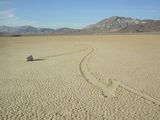
I've been through the desert on a stone with no name.
Photograph by Steve Zappe, MyShot
Hot and Cold Deserts
The largest hot desert in the earth is the Sahara, which is ix million square kilometers (3.5 million square miles). It isn't the hottest place on Earth, though. That stardom belongs to Decease Valley, in California's Mojave Desert. The highest temperature on World was recorded in that location: 56.7 C (134.1 F).
The largest polar desert is Antarctica, at thirteen million square kilometers (v 1000000 square miles). Antarctica boasts the lowest official temperature recorded on Globe: -89.2 C (-128.6 F), recorded on July 21, 1983.
Ascension from the Ashes
The desert city of Phoenix, Arizona, is named for the mythical desert bird that burns to death simply to be reborn, rising from its own ashes. The urban center of Phoenix was congenital on top of the ruins of canals built by the Hohokam people between 500 and 1450 CE. The Hohokam used the canals to irrigate their crops. Mod-solar day residents also rely on an extensive canal organisation to provide irrigation.
Devil of a Storm
Dust devils are mutual in hot deserts. They await like tiny tornadoes, but they outset on the ground rather than in the sky. When patches of ground get very hot, the heated air above them begins to ascent and spin. This whirling column of hot air picks upward dust and clay. These spinning columns of dirt can ascent hundreds of feet in the air.
Freak Floods
Deserts are defined by their dryness. Notwithstanding, flash floods take more lives in deserts than thirst does.
abaya
Noun
long, thin, loose cloak worn by some Muslim women.
accessibility
Substantive
the ease with which a place or matter can exist reached from other places.
suit
Verb
to adjust to new environs or a new situation.
agal
Noun
cord wrapped effectually a kaffiyeh, or head covering, to keep it in place.
agricultural development
Noun
modern farming methods that include mechanical, chemic, engineering and technological methods. Also called industrial agriculture.
Noun
the fine art and scientific discipline of cultivating land for growing crops (farming) or raising livestock (ranching).
ac
Noun
arrangement that cools the air.
Noun
a large volume of air that is generally consistent, horizontally, in temperature and humidity.
Noun
fan-shaped deposit of eroded cloth, normally sediment and sand.
alluvium
Substantive
gravel, sand, and smaller materials deposited by flowing water.
Anasazi
Substantive
(1200 BCE-1300 CE) people and culture native to what is now the southwestern United States. Also chosen Ancestral Puebloans.
ballast
Verb
to hold firmly in place.
ancient
Describing word
very one-time.
Antarctic
Noun
region at Earth's extreme south, encompassed by the Antarctic Circle.
aqueduct
Noun
a pipe or passage used for carrying h2o from a distance.
Substantive
an underground layer of rock or earth which holds groundwater.
aquifer depletion
Substantive
procedure by which people pump more water out of aquifers than can be replaced by rain or snow.
archaeological
Adjective
having to do with the study of ancient people and cultures.
archaeologist
Noun
person who studies artifacts and lifestyles of ancient cultures.
Noun
region at Earth'due south extreme northward, encompassed by the Chill Circle.
approach
Noun
deep channel or canyon, often dry except during wink floods. Too called a wadi.
Noun
cloth remains of a civilisation, such as tools, clothing, or food.
Aswan Dam
Noun
organization of 2 dams in Egypt that control the menstruation of the Nile River for agricultural, electrical, and germ-free uses.
Atacama Desert
Noun
large, nearly rainless desert in western South America.
atmospheric changes
Noun
alterations in the layer of air surrounding the Earth, such as an increment of pollution or humidity.
Noun
a dip or depression in the surface of the country or body of water floor.
Noun
all the different kinds of living organisms inside a given area.
biologist
Substantive
scientist who studies living organisms.
burrow
Noun
small pigsty or tunnel used for shelter.
Noun
single loma or rock formation that rises sharply from a flat mural, unremarkably in a desert.
cactus
Substantive
type of plant native to dry regions.
Cambyses 2
Noun
(?-522 BCE) emperor of Persia.
canal
Noun
artificial waterway.
Noun
deep, narrow valley with steep sides.
carbon dioxide
Noun
greenhouse gas produced past animals during respiration and used past plants during photosynthesis. Carbon dioxide is also the byproduct of burning fossil fuels.
cattle
Noun
cows and oxen.
cell
Substantive
smallest working part of a living organism.
characteristic
Noun
concrete, cultural, or psychological feature of an organism, identify, or object.
cienega
Noun
haven or swampy wetland, usually fed past natural springs.
circulation
Noun
moving in a circular motion.
Noun
complex fashion of life that developed as humans began to develop urban settlements.
Substantive
steep wall of rock, globe, or ice.
climate
Noun
all weather condition conditions for a given location over a period of time.
Noun
gradual changes in all the interconnected weather elements on our planet.
climatologist
Noun
person who studies long-term patterns in atmospheric condition.
Substantive
visible mass of tiny water aerosol or ice crystals in World'southward temper.
atrophy
Noun
sudden, heavy rainfall.
littoral desert
Noun
arid areas commonly found on the western edges of continents near the Tropic of Cancer and the Tropic of Capricorn.
Noun
one of the seven principal land masses on Globe.
cotton wool
Noun
cloth made from fibers of the cotton plant.
Noun
agricultural produce.
cultivate
Verb
to prepare and nurture the country for crops.
Noun
steady, predictable menses of fluid within a larger body of that fluid.
dam
Substantive
structure built across a river or other waterway to control the flow of water.
Death Valley
Substantive
(~3,900 square kilometers/one,500 foursquare miles) dry basin in the U.Due south. states of California and Nevada, the everyman point in N America (86 meters/282 feet below ocean level).
Noun
devastation or removal of forests and their undergrowth.
dehydration
Noun
illness in which the body loses too much h2o.
Noun
area of land that receives no more than 25 centimeters (10 inches) of precipitation a year.
desertification
Noun
rapid depletion of establish life and topsoil, often associated with drought and human activity.
desolate
Describing word
barren, spare, or lonely.
devastate
Verb
to destroy.
Noun
water droplets condensed from the atmosphere onto cool surfaces near the ground.
divert
Verb
to direct abroad from a familiar path.
djebba
Noun
brusque, pullover tunic or shirt worn by men.
dominate
Verb
to overpower or control.
fallow
Adjective
state of minimal growth or activeness.
Substantive
period of profoundly reduced precipitation.
Substantive
a mound or ridge of loose sand that has been deposited by air current.
Noun
tiny, dry particles of textile solid enough for wind to conduct.
Dust Bowl
Noun
(1930-1940) term for the Peachy Plains of the U.South. and Canada when severe dust storms forced thousands of people off their farms.
economy
Noun
system of production, distribution, and consumption of appurtenances and services.
Noun
community and interactions of living and nonliving things in an area.
efficient
Adjective
performing a task with skill and minimal waste.
engineering
Substantive
the art and science of edifice, maintaining, moving, and demolishing structures.
enormous
Describing word
very large.
Noun
imaginary line around the World, another planet, or star running due east-west, 0 degrees latitude.
Substantive
process by which liquid water becomes h2o vapor.
exceed
Verb
to go across the limit.
fertile
Adjective
able to produce crops or sustain agriculture.
fertilizer
Noun
nutrient-rich chemical substance (natural or manmade) applied to soil to encourage establish growth.
fishery
Noun
industry or occupation of harvesting fish, either in the wild or through aquaculture.
fish farming
Substantive
art and scientific discipline of raising and harvesting fish and other seafood, such as shrimp or crabs.
wink alluvion
Noun
sudden, short, and heavy menstruation of h2o.
flourish
Verb
to thrive or be successful.
Noun
clouds at ground level.
forage
Verb
to search for food or other needs.
forest
Verb
to encompass with trees and other vegetation.
Noun
remnant, impression, or trace of an ancient organism.
fossil fuel
Noun
coal, oil, or natural gas. Fossil fuels formed from the remains of ancient plants and animals.
fragile
Noun
delicate or easily cleaved.
geologist
Substantive
person who studies the physical formations of the Earth.
Noun
mass of ice that moves slowly over state.
Noun
increase in the average temperature of the Globe'due south air and oceans.
Gobi Desert
Noun
big desert in Cathay and Mongolia.
government
Noun
system or social club of a nation, state, or other political unit.
grassland
Substantive
ecosystem with large, flat areas of grasses.
grave
Noun
specific place where a body is cached.
gravel
Noun
small stones or pebbles.
grazing animal
Noun
brute that feeds on grasses, trees, and shrubs.
Great Plains
Noun
grassland region of Northward America, betwixt the Rocky Mountains and the Mississippi River.
Light-green Sahara
Noun
(7000-3000 BCE) moist, temperate climate of the present-solar day Sahara Desert during the Neolithic Subpluvial catamenia. Also called the Wet Sahara.
Noun
water institute in an aquifer.
Noun
surround where an organism lives throughout the year or for shorter periods of time.
hinder
Verb
to delay or hold back.
hoof
Noun
thick, horny covering of the anxiety of animals such as horses and cattle.
hostile
Adjective
confrontational or unfriendly.
Noun
amount of water vapor in the air.
hydroelectricity
Noun
ability generated by moving water converted to electricity. As well chosen hydroelectric energy or hydroelectric power.
hydrogen
Noun
chemic element with the symbol H, whose most common isotope consists of a single electron and a single proton.
hygiene
Noun
scientific discipline and methods of keeping clean and healthy.
Noun
thick layer of glacial water ice that covers a large area of land.
industry
Noun
activity that produces appurtenances and services.
Indus Valley Civilization
Noun
(2500-1500 B.C.E.) culture that flourished in the Indus River Valley, in present-24-hour interval Pakistan.
ingenious
Adjective
very clever or smart.
Inland Empire
Substantive
desert region in southern California, consisting of parts of Riverside, San Bernardino, and Los Angeles counties.
insulation
Substantive
cloth used to go along an object warm.
interior desert
Noun
barren area plant in the interior of continents, formed because no moisture-laden winds accomplish them.
kaffiyeh
Noun
curt headdress worn by Arab men and tied with a cord (agal).
kibbutzim
Plural Noun
(singular: kibbutz) Israeli agronomical community organized nether collective principles.
kidney
Noun
organ that removes the waste product products from blood and helps regulate general wellness.
King David
Substantive
(?1050-970 BCE) rex of ancient Israel and major religious effigy for Judaism, Christianity, and Islam.
Noun
the geographic features of a region.
leeward
Adjective
downwind, or facing away from prevailing winds.
legendary
Adjective
famous, heroic, or celebrated.
literature
Substantive
written fabric, including novels, poetry, drama and history.
livestock
Noun
animals raised for human utilise.
lush
Adjective
abundant and rich.
Maghreb
Noun
region in North Africa fabricated of 5 countries: Morocco, Algeria, Tunisia, Great socialist people's libyan arab jamahiriya, and Mauritania.
Substantive
broad, apartment-topped landform with steep sides.
mesquite
Substantive
tree or shrub native to the hot deserts of North America.
microbe
Substantive
tiny organism, usually a bacterium.
Center East
Noun
region of southwest asia and northeast Africa.
migrate
Verb
to move from one place or action to another.
mirage
Noun
optical illusion formed nether certain atmospheric weather condition, in which objects appear to be reflected or displaced.
change
Verb
to change or modify.
Mohenjo-daro
Noun
(2600-1500 BCE) metropolis of the Indus Valley civilisation, in what is today Pakistan.
molecule
Substantive
smallest concrete unit of a substance, consisting of two or more atoms linked together.
Noun
seasonal alter in the direction of the prevailing winds of a region. Monsoon commonly refers to the winds of the Indian Bounding main and South Asia, which often bring heavy rains.
mountain range
Noun
serial or chain of mountains that are close together.
nanoclay
Noun
collection of tiny particles that acts as a binding amanuensis to materials such as sand or plastics.
Native American
Noun
person whose ancestors were native inhabitants of North or S America. Native American unremarkably does not include Eskimo or Hawaiian people.
natural resources
Noun
a fabric that humans take from the natural environment to survive, to satisfy their needs, or to merchandise with others.
neglect
Noun
failure to pay attention.
negotiate
Verb
to discuss with others of dissimilar viewpoints in gild to reach an agreement, contract, or treaty.
nitrate
Noun
blazon of salt used as fertilizer. Backlog nitrates can choke freshwater ecosystems.
nitrogen
Substantive
chemical element with the symbol N, whose gas course is 78% of the Earth's atmosphere.
nocturnal
Adjective
agile at night.
nomad
Noun
person who moves from place to identify, without a stock-still home.
nomadic
Adjective
having to do with a way of life lacking permanent settlement.
notable
Adjective
important or impressive.
Noun
substance an organism needs for energy, growth, and life.
nutrition
Noun
process by which living organisms obtain food or nutrients, and use it for growth.
Noun
surface area fabricated fertile past a source of fresh water in an otherwise arid region.
oil reserve
Noun
petroleum from a specific reservoir that tin can be successfully brought to the surface.
oleander
Substantive
shrub cultivated for its flowers.
organism
Noun
living or once-living thing.
Outback
Noun
remote, sparsely populated interior region of Australia.
overcultivation
Substantive
process of growing besides many crops in too short a time period on one surface area of land.
overgrazing
Noun
procedure of besides many animals feeding on one area of pasture or grassland.
oxygen
Noun
chemical element with the symbol O, whose gas grade is 21% of the World's atmosphere.
pack creature
Noun
domesticated creature used by humans for transporting goods.
Patagonia
Noun
large plateau in southern S America, stretching from the Andes Mountains to the Atlantic Ocean.
Noun
procedure by which plants turn water, sunlight, and carbon dioxide into water, oxygen, and simple sugars.
Substantive
large region that is higher than the surrounding area and relatively flat.
playa
Noun
large, flat expanse of globe covered by a thick layer of salt left past an evaporated saline lake or pond. As well called a salt flat, sink, or common salt pan.
polar desert
Noun
arid area found in the Arctic or Antarctic.
Substantive
all forms in which water falls to World from the atmosphere.
prevailing wind
Noun
wind that blows from one direction.
primary
Adjective
kickoff or most important.
profit
Noun
money earned afterwards production costs and taxes are subtracted.
Noun
dry out land on the side of a mountain facing away from prevailing winds.
rain shadow desert
Noun
arid area found on the leeward side of mountain ranges.
receive
Verb
to get or accept.
resource
Noun
available supply of materials, appurtenances, or services. Resources can be natural or human.
Noun
big stream of flowing fresh h2o.
root system
Substantive
all of a plant'south roots.
rural
Adjective
having to exercise with land life, or areas with few residents.
Sahara Desert
Noun
earth's largest desert, in n Africa.
Sahel
Noun
transition zone in northern Africa between the Sahara Desert in the north and the savanna ecosystems in the southward.
common salt flat
Noun
large, apartment expanse of globe covered by a thick layer of salt left by an evaporated saline lake or pond. Also called a playa, sink, or table salt pan.
sand
Noun
small-scale, loose grains of disintegrated rocks.
scorching
Adjective
very hot.
scour
Verb
to rub harshly, ofttimes to shine.
slash-and-burn
Noun
method of agriculture where trees and shrubs are cleared and burned to create cropland.
snowbird
Noun
person who migrates to warm, dry climates in the wintertime and to cool, dry climates in the summertime.
snowmelt
Substantive
water supplied by snow.
sound bulwark
Substantive
speed of sound, 343 meters per 2nd (1,125 feet per 2d).
spa
Noun
facility, usually with mineral hot springs, offer wellness benefits.
spring
Noun
pocket-size menstruum of water flowing naturally from an cloak-and-dagger water source.
stomata
Plural Noun
(singular: stoma) tiny openings on the surface of leaves that command the exchange of gases in a plant.
harbinger
Substantive
stalks of grain.
subtropical desert
Noun
arid expanse found near the Tropic of Cancer and the Tropic of Capricorn, formed by the circulation of air masses. As well called a midlatitude desert.
sugar pikestaff
Substantive
tall grass that is harvested to excerpt sugar from its sap or juice.
Substantive
use of resources in such a manner that they will never exist exhausted.
Substantive
degree of hotness or coldness measured by a thermometer with a numerical calibration.
thobe
Noun
long, loose robe or tunic made of thin material, usually white and worn by Arabic men.
thunderstorm
Substantive
cloud that produces thunder and lightning, frequently accompanied by heavy rains.
topsoil
Substantive
the most valuable, upper layer of soil, where about nutrients are found.
Tropic of Cancer
Noun
line of latitude 23.v degrees north of the Equator.
Tropic of Capricorn
Noun
line of latitude 23.five degrees s of the Equator.
turban
Noun
man's caput covering consisting of a long piece of material wrapped around a cap or around the head.
unique
Describing word
i of a kind.
Noun
adult, densely populated surface area where most inhabitants take nonagricultural jobs.
Noun
urban center area that is ever warmer than the surrounding area.
vapor
Noun
visible liquid suspended in the air, such as fog.
vegetation
Noun
all the plant life of a specific identify.
versatile
Describing word
able to adjust to different weather condition.
vulnerable
Adjective
capable of being hurt.
wadi
Noun
deep channel or coulee, often dry except during wink floods. Also called an approach.
water rights
Plural Noun
right of a consumer (person, business, or regime) to use h2o from a specific source. Sometimes, water rights include the amount of water a consumer is immune to use.
weather condition station
Noun
area with tools and equipment for measuring changes in the atmosphere.
Noun
area of land covered by shallow water or saturated past water.
whitewater
Noun
fast-moving parts of a river.
Noun
motility of air (from a high force per unit area zone to a depression pressure zone) caused by the uneven heating of the Earth past the sunday.
windbreak
Substantive
structure that serves to interrupt an wind or flow of wind.
windward
Describing word
facing or toward the current of air.
xerocole
Noun
animal that has adjusted to live in the desert.
Source: https://www.nationalgeographic.org/encyclopedia/desert/

Posting Komentar untuk "With Daytime Temperatures That Can Reach 430ã‚â°c, Why Is Nighttime on Mercury So Cold?"